
I met Russell in college when I was a sophomore (that's him on the left and me on the right, being oddly charming in the presence of girls circa 1999). He lived down the hall from me and we piqued each other's interest with our off-beat tastes in music (I was getting into indie rock and weird breakbeat techno, he was all about power pop and being "down with the clown.") One night early on in our friendship, we were talking about where we grew up. It went something like this:
We lived across the street from each other. Not at the same time, mind you, but we both played baseball with the neighborhood kids in the vacant lot next to his house, we both knew about the dirt-bike track back in the woods off State Line Road and we both knew that the guy who lived on the corner was a pederast. After that revelation, Russell and I developed a special bond and a friendship that has endured through tragedy and triumph.
Me: I moved to Toledo when I was in the 6th grade.
Russ: I grew up there. What part?
Me: Well, I guess it wasn't really Toledo that we moved to. It was Sylvania, really.
Russ: Yeah, uh, me too. Where in Sylvania?
Me: Well, I guess it wasn't really Sylvania proper so much as it was Sylvania Township.
Russ: Um, whoa. Me too. Where did you live?
Me: Off of Whiteford Road.
Russ: No. Fuck you. What street?
Me: Janet Avenue.
Russ: <runs away screaming like a dude in a David Blaine special>
In 2005, Russell asked me if I'd come to work for his family's business, a little apparel and merchandise shop out in Versailles, Ohio where his family had moved to just before he started high school. They were looking to expand their sales in the political market to follow up on the mild success they'd had catering to labor unions. I was delivering for a pizza shop at the time and thought it seemed like the adult decision to make, even if I was actually taking a pay cut to do it. A few years later, we were the primary manufacturers and fulfillment house for the Barack Obama campaign. Things were going well, to say the least.

Russell met Elissa and got married in 2009 (that's me presiding over their ceremony, reading the script from a Blackberry). They're perfect for each other in that they're not afraid to dream and they're not afraid to take a risk in support of those dreams so long as they have each other. Elissa moved to Chicago last year to pursue a career in comedy: studying, writing and performing at Second City among other hilarious things. Russell stayed in Ohio, balancing his obligations between his wife and his business by logging entirely too many miles on Interstates 70 and 65. The business, which had been booming in 2008 was hit hard by the recession and limped along for years. As part of a company restructuring, Russell made his exit and started packing for Chicago to be with Elissa again.
Those final developments happened just as I was making plans for this year's TurkeyFest. I called Russ to ask him when he was leaving. He said it would be around December 1st. I asked if we should have TurkeyFest this year; given all of the drama this fall, I wouldn't have held it against him if he just wanted to bolt out of town as soon as he could. "I'll stay for TurkeyFest," he said. It seemed a fitting last hurrah for Russell in Columbus, an appropriate celebration of the changing face of OxFam, but this joyous yearly tradition was taking on a somber tone.
I knew this was going to be a pretty big event - TurkeyFest usually reels in about 20 people over the course of the day - so I talked to my buddy Ryan who owns the Tree Bar here in Columbus about renting the bar out to accommodate the larger-than-normal crowd. I'll take this opportunity to plug the Tree Bar: one of my favorite places to drink and watch rock shows also happens to be an excellent place to throw a private party on a Sunday night. Thanks Ryan...
ASIDE: Yeah, this happened a while ago and you may not find these descriptions of turkey preparation helpful for quite some time, but if you're looking for some interesting ways to prepare a Christmas bird, maybe these will give you some ideas. SPOILER ALERT: all three of my turkeys turned out great, and I honestly don't know if I could pick a favorite.
I had 3 birds: a 13 pounder, a 14.5 pounder and a mammoth 19.5 pounder. I don't usually like to cook big birds like that because they take forever and have a tendency to dry out. More on my plan to combat that in a second. This year's theme was "Smoke 'Em If You Got 'Em." Since I had such good luck with smoke in the summer, I decided to introduce a smoke element to every bird. The 19.5 pounder would get slow cooked in the smoker, the 14.5 pounder would be soaked in a smoked beer brine and grilled, and the 13 pounder would be the old tried-and-true "spicy turkey" but with chipotle peppers instead of sport peppers.
On Friday night (two days before the party), I pulled out the big bird and made a simple brine (standard gallon of water, 1 cup kosher salt and 1/2 cup brown sugar, plus some garlic and Worcestershire sauce for flavor). I ended up disassembling the turkey before brining: first I detached the drum sticks and wings, then I cracked the backbone to separate the breast from the thighs. If I had kept the bird whole, it would've taken forever to cook in the smoker. This way, I cut the cooking time considerably and fended off any drying out by brining and making all the pieces smaller.
On Saturday morning, I spatchcocked the 14.5 pound bird, cutting out the backbone, breaking the breast plate and removing the keel bone before laying it flat. I made a brine with two smoked beers - 2 pints of Aecht Schlenkerla Marzen (a heavily smoked lager beer from Germany) and 3 pints of Dark Horse Fore smoked stout (part of the Dark Horse brewery's winter stout series) - plus a little apple cider and vegetable stock. That bird sat in the brine for about 24 hours.


I had never spatchcocked any bird before. It seems involved, but it really does cut the cooking time down and isn't nearly as hard as it sounds. This method would also come in really handy later on, as I was scrambling to get everything done. More on that in a bit.
Later that morning, I made a chipotle brine for the 13 pound turkey with a whole can of chipotle peppers, cumin, oregano and paprika. That bird also sat in the brine for about 24 hours.
Saturday night, I took out a few handfuls of oak wood chunks and put them in a pan, then emptied a bottle of Old Crow whiskey so they could soak it up. My hope was that I would get the same effect as using oak from old bourbon barrels. I have two old bourbon barrels in my basement, but Erin won't let me chop them up into homemade smoker chunks.

Sunday morning, I started the smoker up around 9 o'clock and put my bird pieces on over the bourbon-soaked wood chunks about an hour later. It took me a while (and the addition of a lot more hot coals) before I finally got the smoker temperature up to where I wanted it, but the oak smoke kept hitting the meat, so I was OK with it even though I knew I was going to have a timing problem at the end of the day.
I decided to do the spicy turkey ASAP so I could clear up room in the oven for the smoker bird, if it came to that. Here's how it works: first you season two sticks of butter with salt and cayenne pepper. If I had been thinking clearly, I would've used the ground chipotle pepper I have in the pantry. Hindsight 20/20 on that one, I suppose.


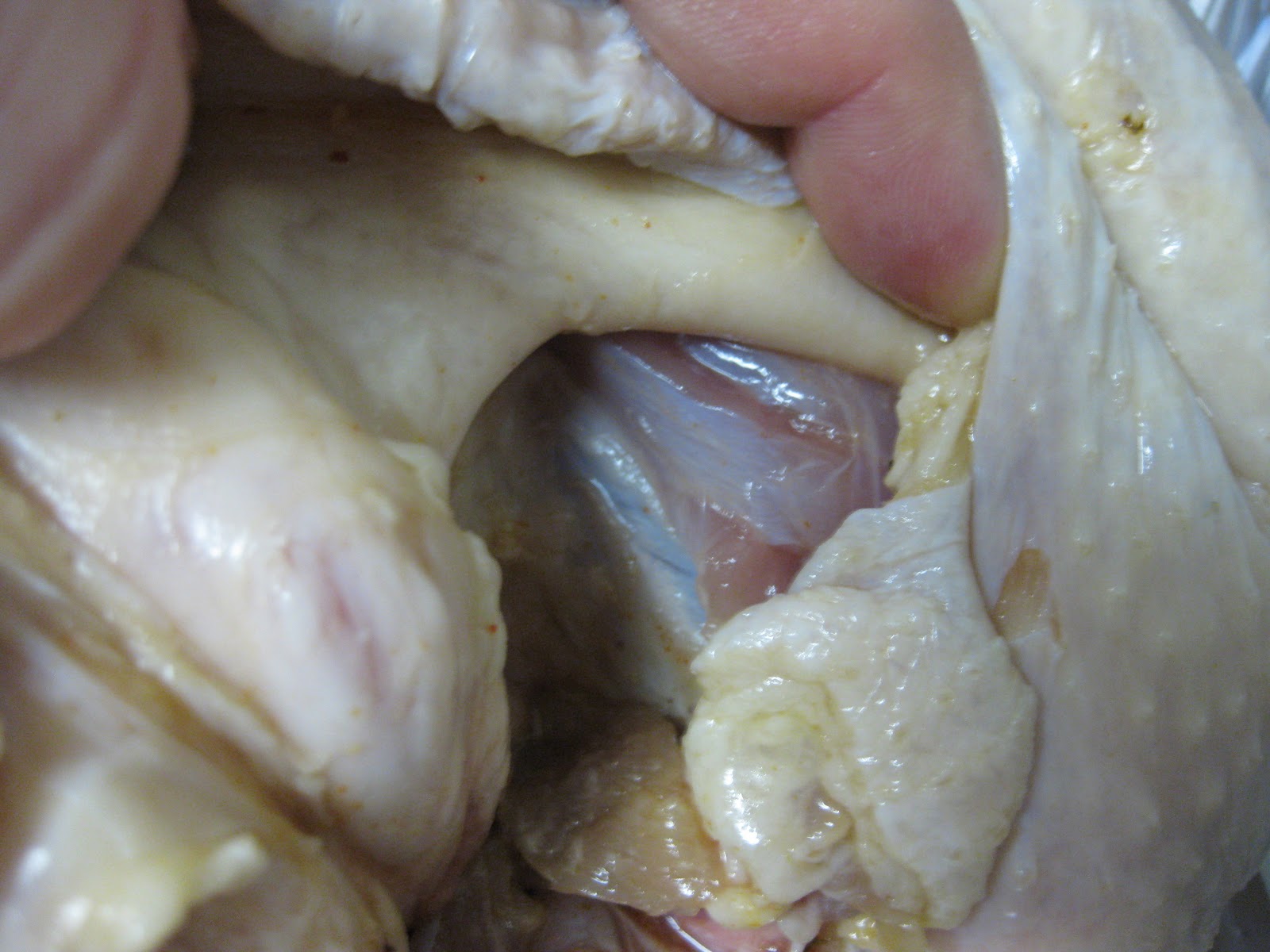

After you're done stuffing all those slits in the breast meat (and hell, why not flavor up the thighs, legs and wings too, if you're feeling so bold), throw any leftover stuffing into the cavity and truss your bird closed. If you've never trussed a turkey, chicken or other poultry, I highly recommend it. Not only does it cut down on cooking time since you're making a nice uniform roast out of a gangly bird, but the finished product is Norman Rockwell-quality and perfect for "oohs" and "ahhs" before carving at the table. It's also relatively easy to do, plus you get to learn a new knot.


Season the outside of the bird with salt and cayenne pepper (again, for this variation I should've used ground chipotle pepper). Start the bird breast side down: you want to protect the delicate breast meat from the high initial heat. Roast it at 450 for 20 minutes, then turn the heat down to 350. 90 minutes into the process, flip the turkey over so the breast side is up. If it looks pale, don't worry: it's got 90 minutes to brown up. After 3 hours, the turkey should be up to a safe temperature (165 in the breast) and should look and smell amazing. This is a show-stopping crowd pleaser, ladies and gents.

I fired up my Weber kettle grill with charcoal and had the spatchcocked bird on by 1 o'clock. The primary advantage to spatchcocking is that it speeds up the cooking process, but I was having trouble with keeping my grill hot too. I made a "ring of fire" around the outside of the grill to indirect cook the bird and keep the temperature uniform, but I don't think I had enough coals to start, so when I put the lid on the fire just petered out.

When the spicy bird was out (about 3 o'clock), I temp checked the smoker bird and the spatchcocked bird. They were both around 130-140 in the breast, so despite my fire troubles, I was most of the way there. I transferred both turkeys to the 350 degree oven (spatchcocking a bird meant it could lie flat on the bottom rack while the smoked bird stood tall on the middle rack; plenty of oven space) and let them cook in there until they got to safe temp. The oven finish also crisped up the skin in a very nice way.
While those birds were in the oven, I set a 12 oz. package of cranberries in foil on the smoker for about an hour and a half, then attempted to make a BBQ sauce with them but I couldn't get the texture right. I adjusted the flavor to something that was acceptable and decided not to call it BBQ sauce anymore. I also made a vegetarian apple cider gravy: starting with a standard roux base, I added apple cider and vegetable stock at about a 5:1 ratio, plus some onion powder and ground ginger.
Everything was done by 4 o'clock except the smoked turkey thigh meat which took another 25 minutes or so. I had to rest everything before carving, and I was pushing up against my deadline (party was starting at 5), but we got out the door by 5:10 with three turkeys in tow and ended up being only fashionably late to the party instead of tragically late.


Not to brag or anything, but all three of my turkeys were juicy and fork tender in addition to be remarkably flavorful. I think my only stumble is that the spicy turkey wasn't bursting with that smoky chipotle flavor that I was going for; I should've used more chipotles in the stuffing and replaced the cayenne with ground chipotle pepper. The spatchcocked bird had an almost decadent richness to it from the deep, complex maltiness of the smoked stout brine. The smoked turkey appeared to steal the show, though. Wood smoke is a tough element to get right: too little and it's not worth the effort, too much and it can mask the meat with undesirable bitterness. I got just the right amount of smoke flavor in the bird and it was gobbled up (bad pun, sorry) in no time.
Actually, we had about 30 people and within an hour of opening the buffet line, all the carved white meat and most of the dark meat on all three turkeys was gone. All that was left were legs and wings. I was actually kind of disappointed that there were two renaissance fair-quality smoked turkey legs sitting in the buffet warmer at the end of the night. I quickly got over that when I accepted the reality that I would get to eat those.
Surprise of the night: the cranberry sauce that I was not particularly fond of ended up being the hit of the party. Just goes to prove that sometimes you get rewarded just for showing up. It's a lot like friendship: even when you don't think what you're doing is earth-shattering, you never know what it's going to mean to a friend. That's what I'm going to miss most with Russell not being in my neighborhood anymore. Dude always showed up, I just don't know if I ever let him know how much it meant to me.


